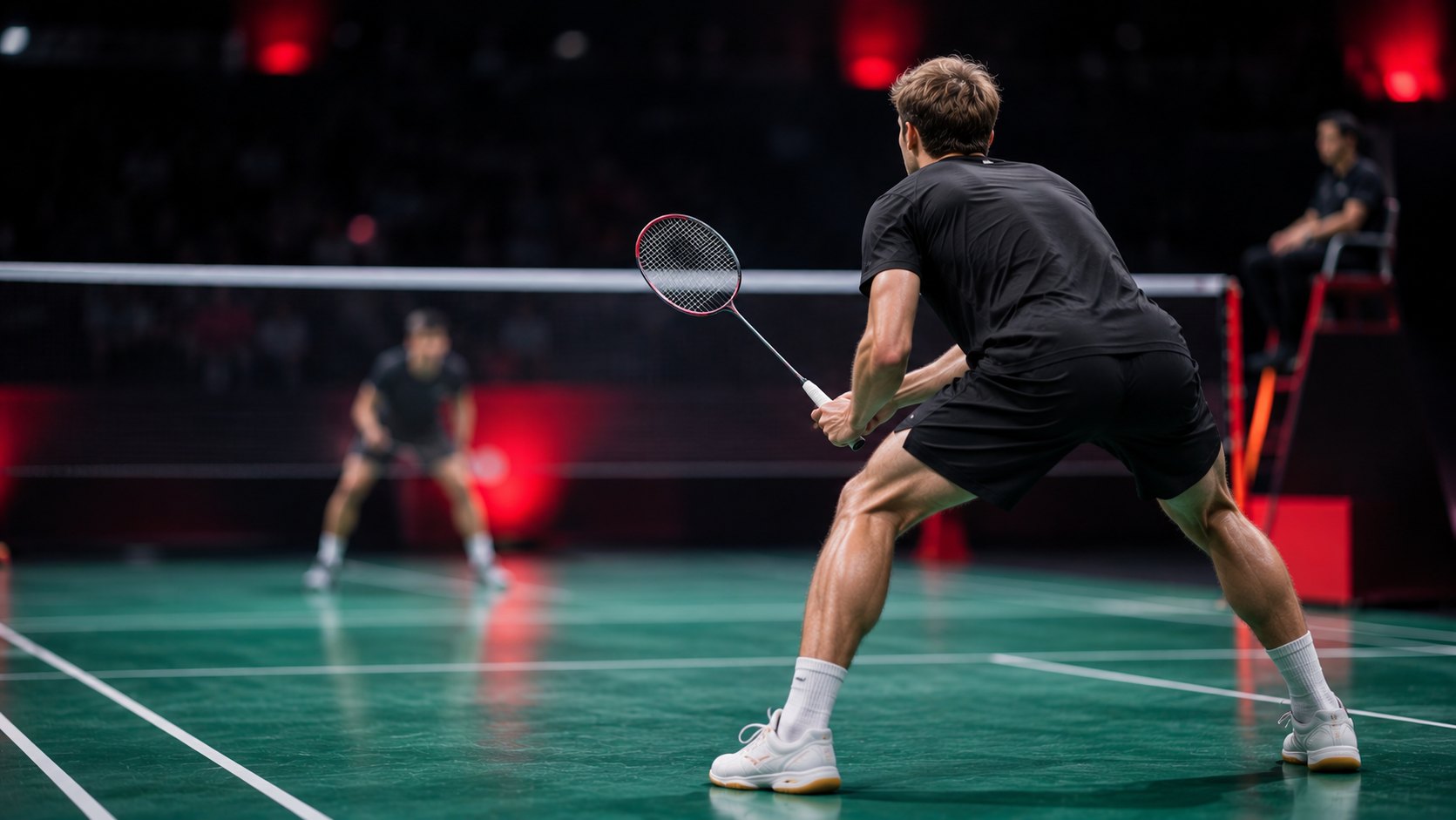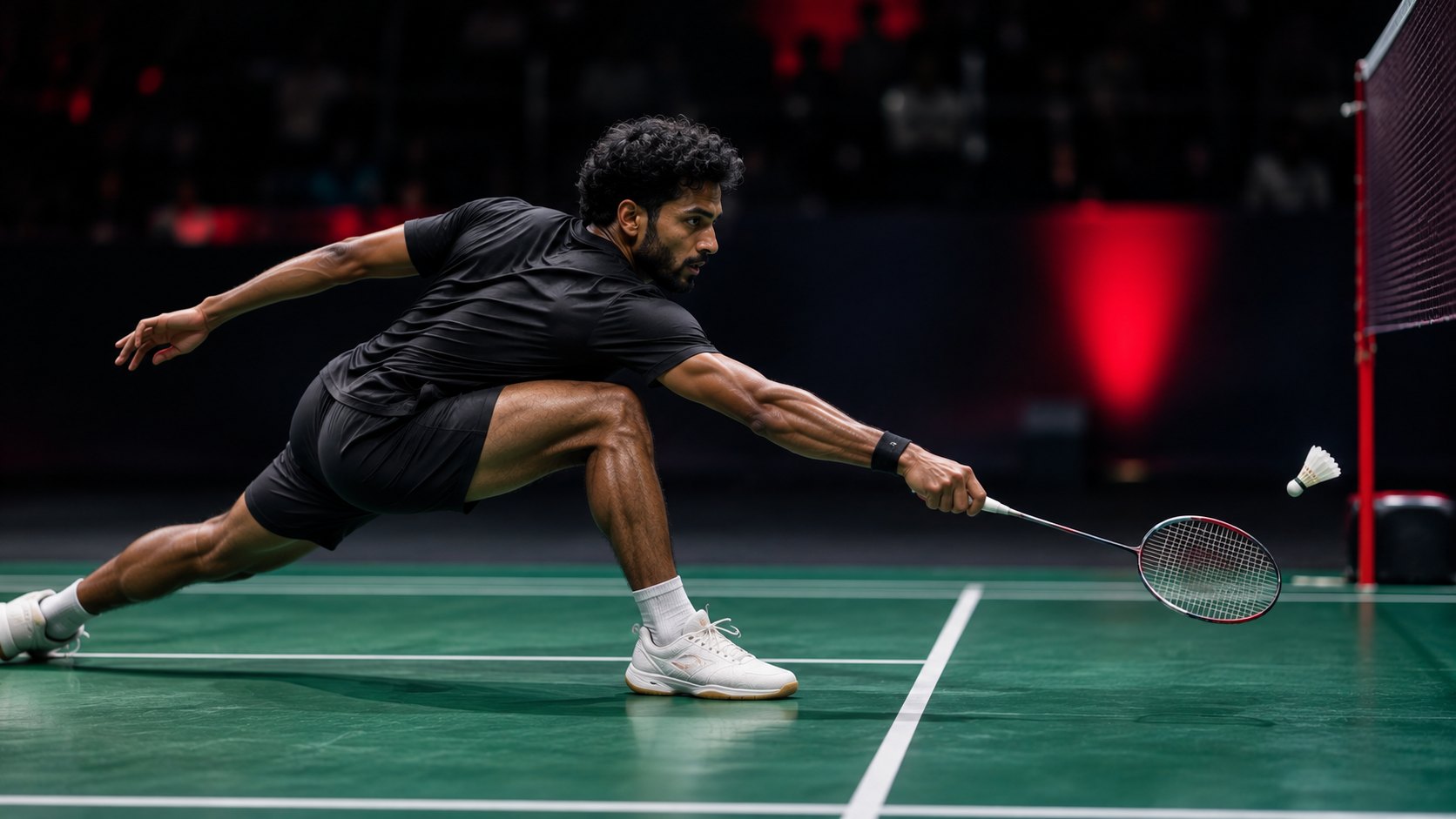
Feather shuttles fly better and cost more. Nylon shuttles last longer and fly worse. That is the whole feather vs nylon debate in two sentences, and if you play competitively the answer is already made for you: every sanctioned tournament uses feathers. The interesting questions are which grade of feather you can afford to train with, which nylon is least bad when you can’t, and how to read the speed numbers so the tube you buy actually suits your hall.
How the two fly
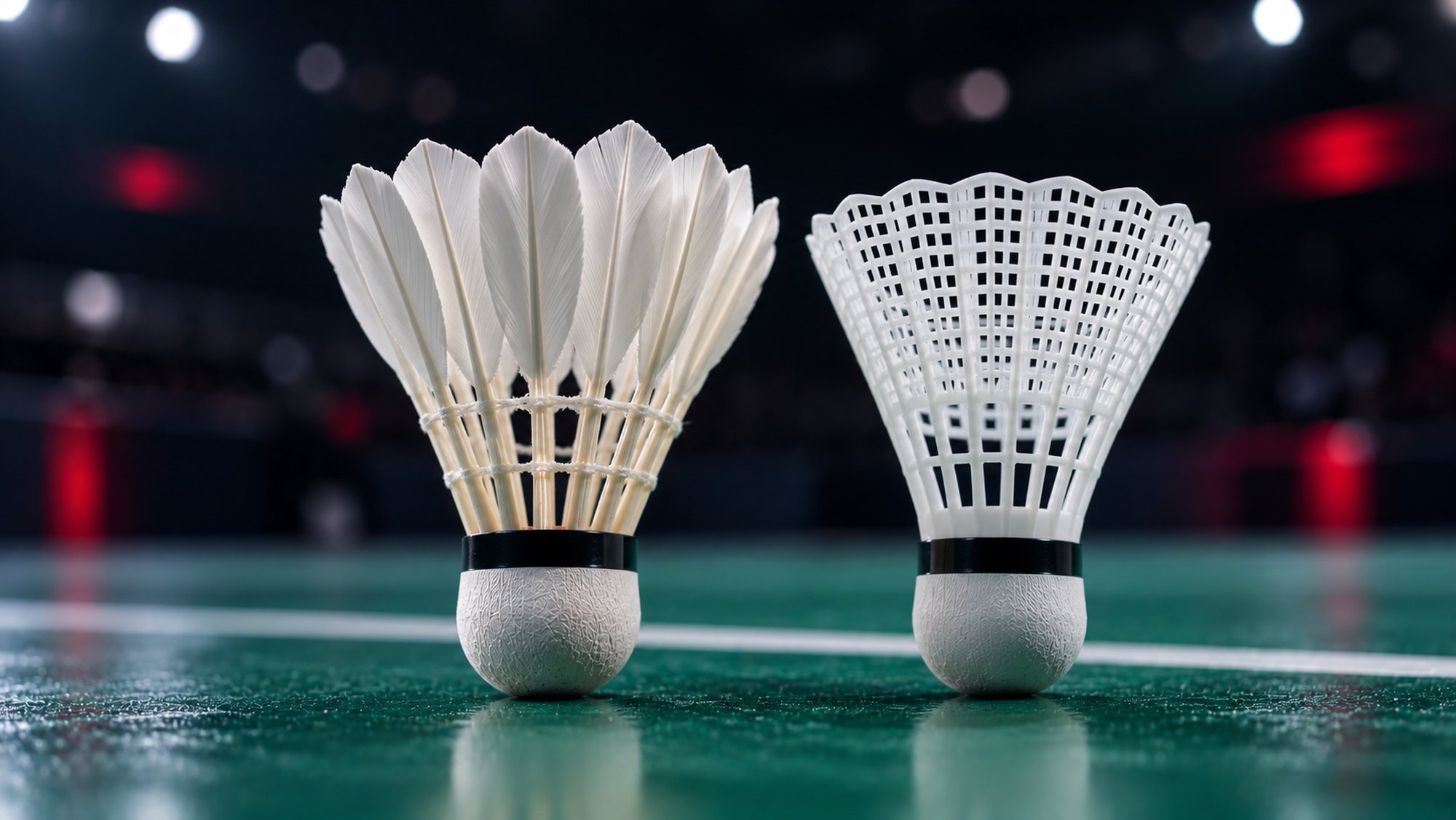
A feather shuttle has 16 goose or duck feathers set into a cork base, as required by Law 2 of the BWF Laws of Badminton, which also fixes the weight at 4.74 to 5.50 g and the feather length at 62 to 70 mm. The feathers create a lot of drag, which is why a feather shuttle leaves a professional’s racket at over 300 km/h on a full smash and still drops almost vertically by the time it crosses the net. That steep deceleration is what gives badminton its character: the smash is brutal, the net shot tumbles, the clear hangs and falls.
A nylon shuttle has a one-piece plastic skirt on a cork or composite base. The skirt deforms on impact and springs back, which is why it survives mishits that would snap a quill. But the skirt also decelerates less than feathers, so a nylon shuttle flies flatter, holds speed longer and arrives at the back of the court with more pace. Clears sail long until you adjust, drops don’t fall as sharply, and spinning net shots barely spin. Good players notice the difference inside two rallies.
| Feather | Nylon | |
|---|---|---|
| Flight | Steep deceleration, true trajectory, spins on slices | Flatter, carries further, little spin |
| Durability | A good tube of 12 might last a club night; a single clipped quill ends a shuttle | One shuttle can last several games |
| Cost per shuttle | Roughly 2–6 USD depending on grade | Roughly 1.50–3 USD |
| Cost per hour | High | Low |
| Used in sanctioned tournaments | Yes | No, with rare lower-level exceptions |
| Best for | Match practice, anything above casual club level | Beginners, kids, PE classes, warm-ups, outdoor-ish halls |
Speed numbers: 76, 77, 78 and what they mean
Shuttles are made in several speeds because air density changes how far they fly. Warm, humid or high-altitude air is thinner, so a shuttle flies further and you need a slower one. Cold, dense air at sea level needs a faster one.
Feather shuttles are usually graded 75 to 79. Yonex also prints its own scale of 1 to 5 on the tube, where 1 is slowest and 5 fastest; the two scales line up so that Yonex 2 is 76, 3 is 77, 4 is 78. The temperature ranges below are widely published guidance and overlap at the edges, so treat them as a starting point rather than a rule.
| Speed | Yonex number | Roughly suits | Typical conditions |
|---|---|---|---|
| 75 | 1 | 33 °C and above | Hot tropical halls, high altitude |
| 76 | 2 | 27–33 °C | Warm halls, Southeast Asia, Indian summer |
| 77 | 3 | 22–28 °C | Standard heated hall; the most common speed worldwide |
| 78 | 4 | 17–23 °C | Cool European and North American halls in winter |
| 79 | 5 | 17 °C and below | Cold, unheated halls at sea level |
Nylon shuttles use coloured caps instead: green is slow, blue medium, red fast. Yonex’s stated ranges for Mavis caps are green 22–33 °C, blue 12–23 °C and red 0–13 °C. In practice most clubs in temperate countries use blue; most in hot climates use green.
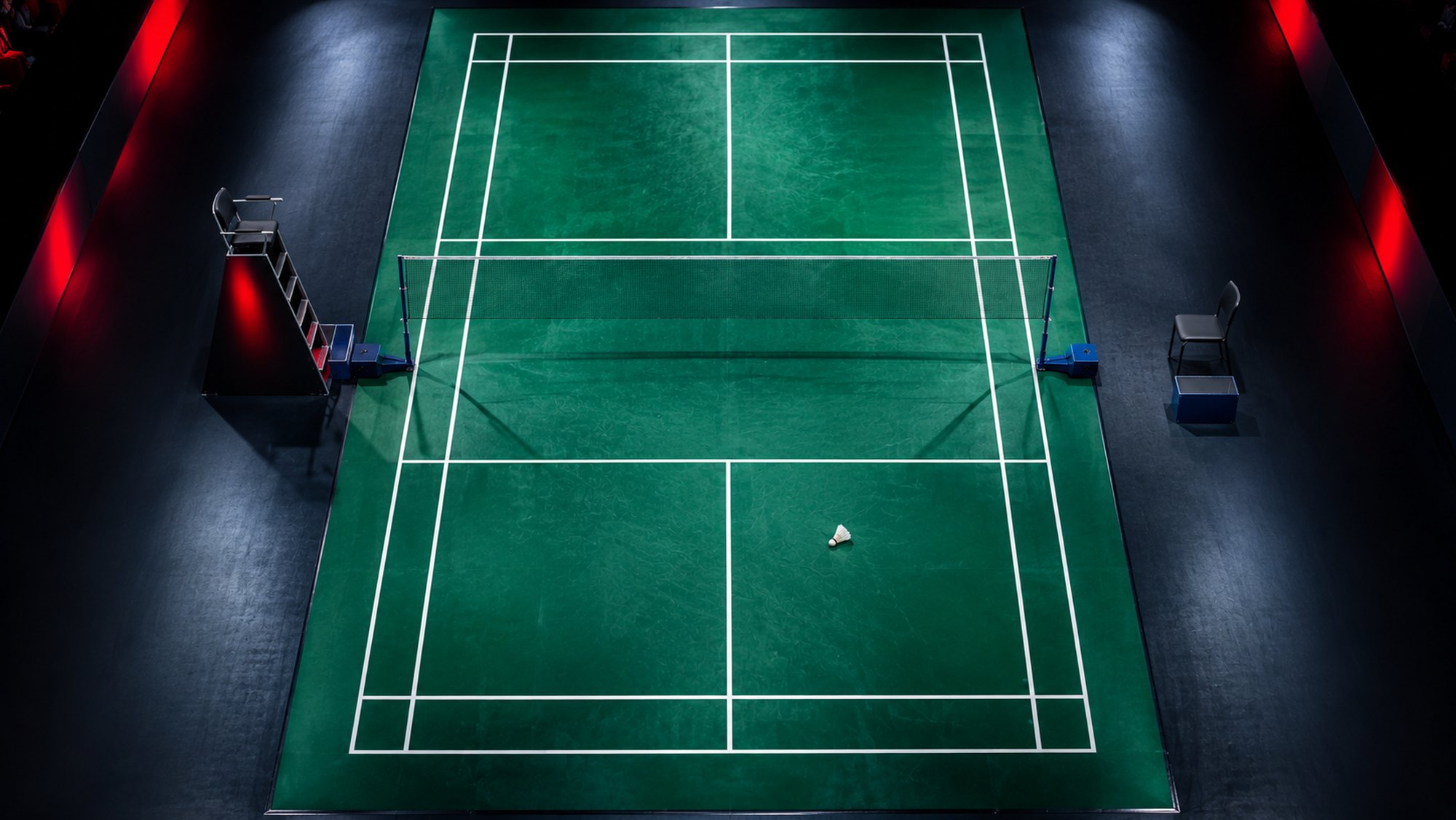
The test is simple and it is in Law 3 of the Laws of Badminton: standing over the back line, hit the shuttle with a full underhand stroke, parallel to the sidelines. A correct-speed shuttle lands between 530 mm and 990 mm short of the far back line, which puts it roughly on or around the doubles long service line (760 mm from the back line). Short of that and you need a faster number; past it and you need a slower one.
Which grades are standard
Grade matters more than brand. Within every brand’s range the cheap feather shuttles use lower-quality or duck feathers and composite cork; the expensive ones use selected goose feathers and solid natural cork. Here is where the names you’ll see in shops actually sit.
Yonex Aerosensa
- AS-50: the top tournament grade, goose feather, used at many of the sport’s biggest events. Durable for a feather, expensive, and the benchmark against which other shuttles are judged.
- AS-40: one step down, goose feather. Good enough for national-level events and a sensible choice for serious club match play.
- AS-30: the value grade in the Aerosensa line, goose feather, less durable than the 40 and 50 but consistent. The usual choice for club training where feathers are mandatory.
Yonex Mavis (nylon)
- Mavis 350: the standard club nylon, premium nylon skirt, sold in tubes of six. The default for beginners and school programmes.
- Mavis 2000: Yonex’s top nylon. Natural cork base and a refined “wing rib” skirt that Yonex says gives more feather-like deceleration and more stable flight. Lasts a little longer than the 350 and costs more. The best nylon option for a club that wants something close to feather flight without the bill.
Li-Ning A+ series
Li-Ning’s feather range runs from the A+ 40 up to the A+ 600. The A+ 100, A+ 300 and A+ 600 are goose-feather shuttles on the BWF approved list, with the A+ 600 the top grade. The A+ 90 is a goose-feather provincial-level shuttle, and the A+ 60 and A+ 70 are goose-feather training shuttles. The A+ 40, A+ 50 and A+ 80 use duck feathers. For club training, the A+ 60 is the usual comparison point against the Yonex AS-30.
Victor Champion and Master
Victor splits its range by feather. The Master series is goose feather: the Master Ace is Victor’s top tournament shuttle and the one used at most Victor-sponsored events, and the Master No.1 is the BWF-approved grade below it, both with solid natural cork. Higher Master numbers (No.3 and up) move to composite cork and are training shuttles. The Champion series is duck feather; the Champion No.1 is BWF-approved and a popular value tournament shuttle, and higher Champion numbers are training grades. Victor also sells a line of nylon shuttles numbered 400 to 3000, with the 2000 and 3000 on natural cork.
Training vs matches: how to choose
You are a beginner or play casually. Nylon. A tube of six Mavis 350 or Mavis 2000 will last weeks, and the slightly flatter flight won’t hold you back while you are learning to hit the middle of the strings. Move to feathers when your clears reach the back line consistently and you start working on drops and net play.
You play club badminton and some tournaments. Train on a mid-grade goose feather (AS-30, Li-Ning A+ 60, Victor Master No.3 or similar), match-play on the grade your tournaments use. The transition from nylon to feather costs you a week of timing every time you make it; avoid making it the day before an event.
You play competitively. Feathers only, and ideally the grade your events use so the flight is identical. Use last week’s slightly tired shuttles for drills and the fresh tube for games.
Your hall is cold, hot or at altitude. Fix the speed before you blame the brand. One number up or down changes the flight far more than a grade change does.
Steaming and tipping: making feathers last
Feather quills dry out in storage and in dry heated halls, and a dry quill snaps. Two tricks that club players have used for decades.
Steam. Hold the open end of a tube over a boiling kettle for ten to fifteen seconds, or over a pan of just-boiled water for a minute or two, then cap it and leave it overnight. The feathers absorb moisture and become more flexible. Don’t soak them, and don’t do it to a tube you’ll play in the next hour: wet feathers fly slow and heavy.
Humidify. The lazier version. Put a damp (not dripping) sponge or a piece of wet kitchen towel in the cap end of the tube, or keep tubes in a plastic box with a humidifier packet, for a day or two before use. Many clubs store their shuttles like this permanently.
Tipping. If a hall is too fast and you have no slower shuttles, bend the tips of the feathers slightly outward to widen the skirt and add drag, which slows the shuttle. Bending them inward does the opposite. Do it evenly to four or eight opposite feathers, a millimetre or two at most, or the shuttle wobbles. Tipped shuttles are not legal for sanctioned matches, but for a club night it beats a shuttle that flies out on every clear.
Start with one tube
Buy one tube of 77 (Yonex 3, or blue cap in nylon) and test it with the Law 3 service test in your own hall. If it lands short, go to 78; if it lands long, 76. Then settle the grade: nylon until your clears reach the back line, mid-grade goose feather for training after that, and whatever your tournaments use for matches. Our rackets and string tension guide cover the other half of the equation.