Why the world’s fastest racket sport is worth your time
It is the quickest hit in any racket sport, one of the oldest titles in sport, and a game you can start in an afternoon. Here is what makes it special, who made it great, and how to begin.
565km/hFastest recorded hit, set in a test session in 20231
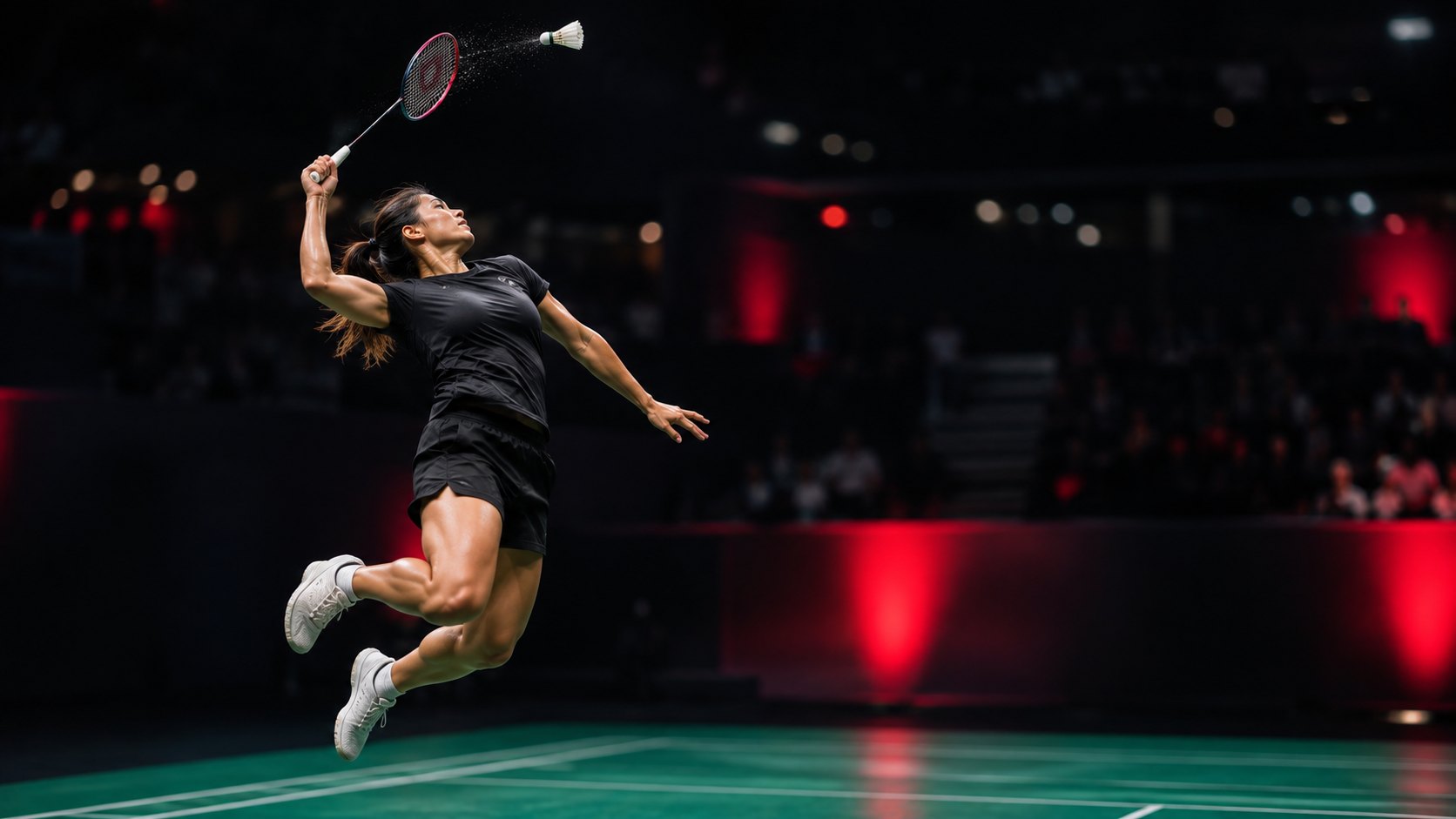
A shuttlecock leaves a top player’s racket faster than anything else in racket sport, then loses most of that speed before it reaches the other side. That odd combination, brutal speed and sudden slowness, is the whole game.
The fastest hit in racket sport
The Guinness World Record for the fastest badminton hit belongs to India’s Satwiksairaj Rankireddy: 565 km/h, measured with a high-speed camera at a Yonex gymnasium in Saitama, Japan, on 14 April 2023. Malaysia’s Tan Pearly set the women’s mark the same day, 438 km/h.1,2,3 Those were set in a test session, not a rally. The fastest hit recorded in competition is Mads Pieler Kolding’s 426 km/h in an Indian league match in January 2017.4
A projectile that brakes itself
A shuttle weighs about five grams and is shaped like an open cone of 16 feathers, so air resistance dominates its flight.12,6 Instead of a smooth arc it flies fast and flat, then drops almost vertically. Physicists in France found that above a certain launch speed, hitting it harder barely adds distance: drag eats the extra pace. They called it the aerodynamic wall.5 That is why a clear needs timing more than muscle, and why a drop shot can die a metre past the net.
Same launch, different flight: a ball follows a near-symmetrical arc, while drag turns a shuttle’s path into a steep fall. Schematic, not to scale.6,5
Reflexes you can train
Because the shuttle starts so fast, rallies at the top level are decided by reading the opponent’s body before contact, not by reacting after it. The good news for newcomers is that this is a skill, not a gift. Early split steps, a ready racket and watching the hitter’s shoulders all buy time, and they come with practice.
A game for almost everyone
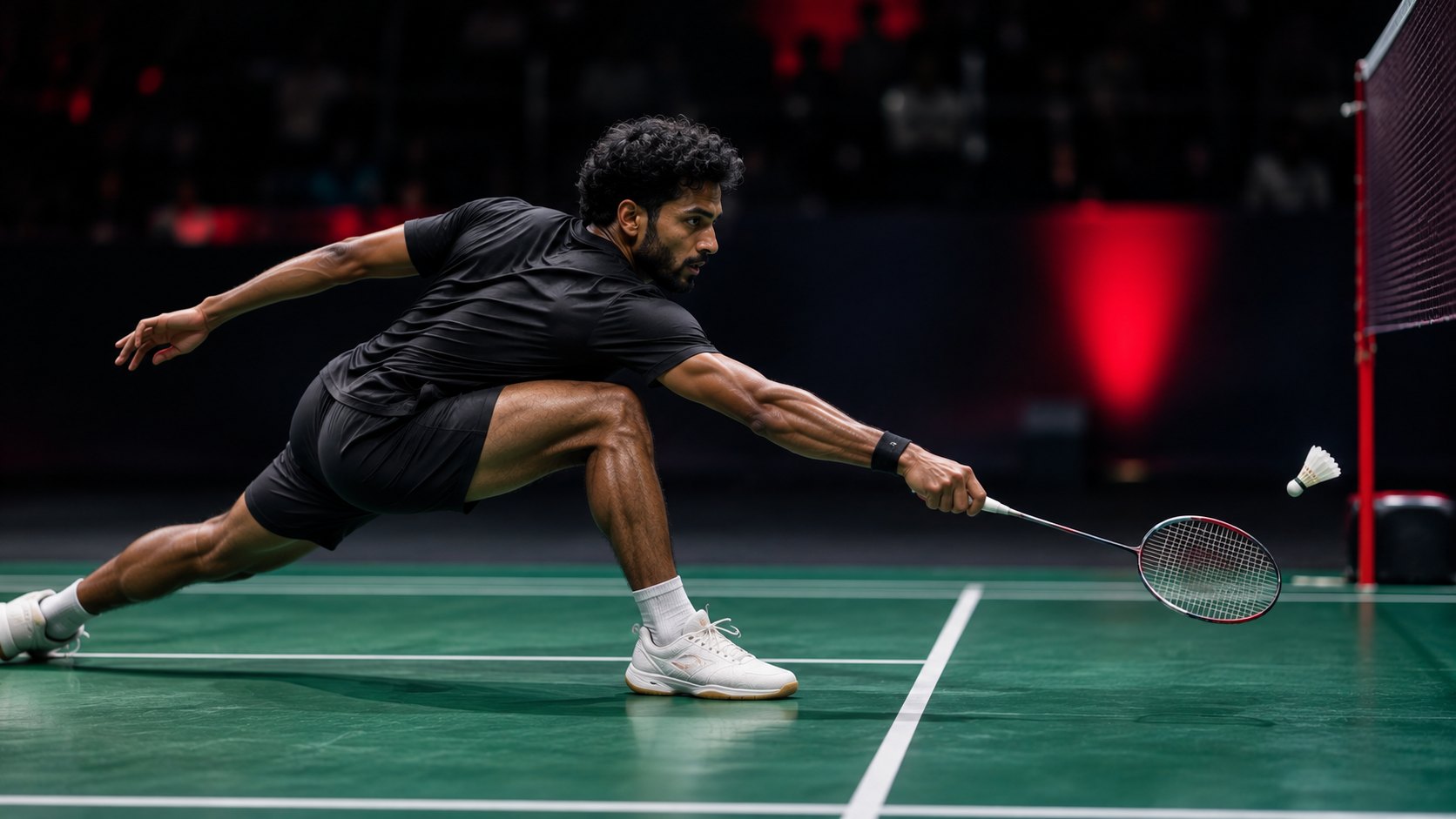
You can play a gentle rally with a child on the first day and still be learning at 70. Doubles cuts the court you cover in half, and para badminton, played seated in wheelchairs and standing, has been on the Paralympic programme since Tokyo 2020.7 As for how many people play, BWF says more than 300 million.8 That is the governing body’s own figure, not an independent count, so treat it as a ballpark; BWF’s separate fan study put followers of the sport at about 709 million.9
AI-generated image
Singles, doubles and mixed
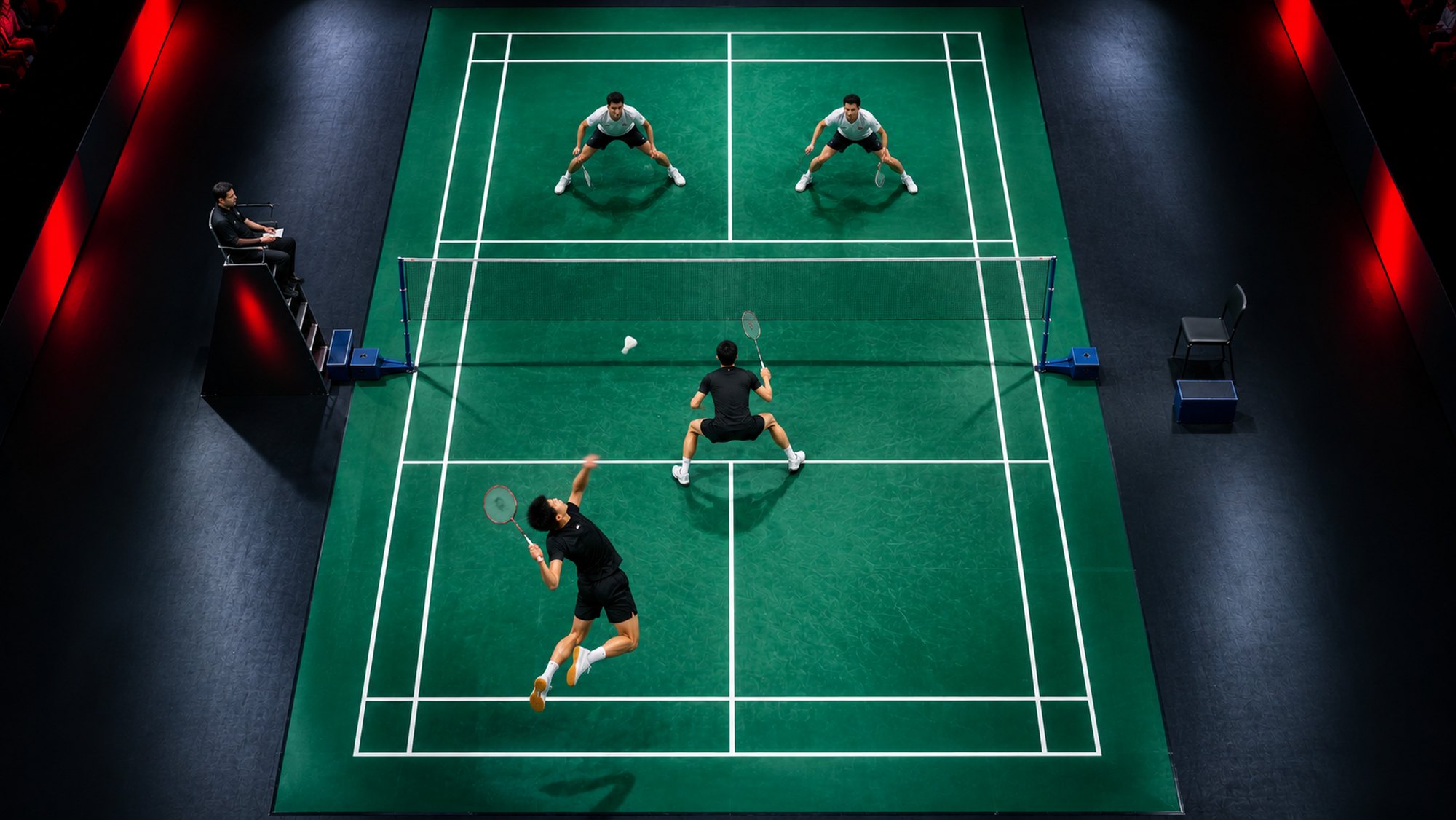
The court is 13.40 m long. Singles uses the narrow inner side lines (5.18 m), doubles the full 6.10 m.10 Five events are played at the Olympics and on the tour.17
SinglesOne against one. Long rallies, deception and a lot of running. The purest test of fitness.
DoublesTwo against two. Faster, flatter, more attacking. Pairs rotate between front-and-back attack and side-by-side defence.
MixedA man and a woman per side. Classic roles put one player at the net and one at the back, though the best pairs blur them.
Who played what first is hazy, and historians still argue over the details. What is clear: the modern game took shape among British officers in India and in English country houses in the 1870s, got its rules in the 1890s and its world body in 1934.12,13
The scoring has changed more than once. Rally-point scoring to 21 arrived in 2006, and games go to 15 from January 2027.18,20
Games with a feathered shuttle go back centuries across Asia and Europe. In China, jianzi, a kicking game with a weighted shuttle, is generally dated to the Han dynasty.11,13
1860s–70s
Poona
British army officers in India play a net version of battledore and shuttlecock, called “Poona” after the town of that name (now Pune).12,13
c. 1873
Badminton House
The game is played at the Duke of Beaufort’s estate, Badminton House in Gloucestershire, which gives the sport its name.12,13
1893
The rules go national
The Badminton Association of England publishes a common set of rules, built on regulations drawn up at the Bath Badminton Club in 1887.13
1899
All England
The first All England Championships are held, doubles only at first; singles follow in 1900.12,13
1934
A world body
Nine national associations found the International Badminton Federation on 5 July 1934.14,15
1972
Olympic preview
Badminton appears at the Munich Olympics as a demonstration sport.12,17
1992
Olympic medals
Barcelona hands out the first Olympic badminton medals in four events. Mixed doubles joins in 1996.17,12
2006
Rally point and a new name
Every rally now scores, with games to 21. The IBF renames itself the Badminton World Federation.18,19,15,16
2021
Paralympic debut
Para badminton is played at the Tokyo 2020 Paralympic Games, held in 2021.7
2027
Games to 15
From 4 January 2027, BWF-sanctioned play switches to 3x15 scoring, approved by member associations in April 2026.20,21
03 · The greats
Twelve players who shaped the game
Not a ranking, and not the only possible list. These are the players whose results, or whose style, changed what people thought badminton could be. Ordered roughly by when they peaked.
Seven in a row from 1968 to 1974, then an eighth in 1976. Nobody has won more men’s singles titles there. World champion in 1980.22,23
INAWomen’s singles
Susi Susanti
1990s
1992Olympic champion
Won Indonesia’s first Olympic gold in any sport in Barcelona, then the world title a year later. She also won the All England four times.24,17
KORMen’s and mixed doubles
Kim Dong-moon
1990s–2000s
2Olympic golds, two events
Mixed doubles gold in 1996 and men’s doubles gold in 2004. The only Korean to win Olympic gold in both.26,17
CHNMixed and women’s doubles
Gao Ling
2000s
4Olympic medals
Mixed doubles gold in 2000 and 2004 with Zhang Jun, plus a women’s doubles silver and bronze. Olympics.com counts four as the most by any badminton player.25,17
CHNWomen’s singles
Zhang Ning
2000s
2Olympic golds
Won in Athens and again in Beijing at 33, the first player to defend an Olympic singles title.27,17
DENMen’s singles
Peter Gade
1990s–2000s
1999All England champion
World No. 1 at the turn of the century and five times European champion. The deception and flair that a generation of club players tried to copy.28,29
CHNMen’s singles
Lin Dan
2000s–2010s
2 + 5Olympic and world titles
Olympic champion in 2008 and 2012, world champion five times, six All England titles. Widely called the greatest of all time.30,31,23,32
MASMen’s singles
Lee Chong Wei
2000s–2010s
3Olympic silvers
Three straight Olympic finals, all silver, and close to 350 weeks as world No. 1, including 199 in a row.33,34
ESPWomen’s singles
Carolina Marín
2010s–2020s
2016Olympic champion
Rio gold made her the first player from outside Asia to win Olympic women’s singles. Three world titles, in 2014, 2015 and 2018.35,17
TPEWomen’s singles
Tai Tzu-ying
2010s–2020s
214Weeks at world No. 1
The longest reign in women’s singles history, built on wrist deception nobody could read. Olympic silver in Tokyo.37,38
DENMen’s singles
Viktor Axelsen
2010s–2020s
2Olympic golds
Champion in Tokyo and Paris, world champion in 2017 and 2022. The first European to win back-to-back Olympic singles titles.36,17
Badminton is a workout disguised as a game. The studies below are encouraging, but most show associations rather than proof of cause, so read them as good reasons to play, not promises.
A study of 80,306 British adults followed for about nine years found racket-sport players (badminton, tennis and squash) had a 47% lower risk of death from any cause and a 56% lower risk of death from heart disease and stroke than people who did no racket sport. It was observational, so it cannot prove the sport caused the difference.40,41
Real exercise intensity
The Compendium of Physical Activities rates social badminton at 5.5 METs and competitive match play at 9.0, firmly in moderate-to-vigorous territory.42 WHO advises adults to get at least 150 minutes of moderate activity or 75 of vigorous activity a week; two club nights can cover a good share of that.43
A sharper mind, for a while
In a small Japanese study of 20 students, ten minutes of badminton improved performance on a Stroop test of inhibitory control compared with sitting still, while ten minutes of running at matched intensity did not. The authors suggest the thinking demands of an open-skill sport may be part of the effect.44
People, not just exercise
A systematic review of sport and adult wellbeing found participation linked to better wellbeing, lower stress and better social functioning, with club-based sport showing stronger links than exercising alone. Most of the evidence is cross-sectional.45 A club night, with its rotating partners and chat between games, is that kind of sport.
Good for life, says the review
A 2022 systematic review of 27 studies on badminton and health concluded that playing may improve health across physical, mental and social areas, with the strongest evidence for physical health such as heart and lung function.46
Hit it twice as hard and it barely goes further. Badminton rewards timing, and timing does not retire at 40.
General information, not medical advice. If you have a heart condition, a joint problem or any other health condition, or have not exercised for a while, check with a doctor before you start.
AI-generated image
05 · Off the court
Look after your body
Badminton asks a lot of ankles, knees and shoulders: hundreds of lunges and overhead swings in a session. Ten minutes of preparation and two short workouts a week go a long way.
Off the court: look after your body
A 10-minute warm-up
Start slow and build. A warm-up should leave you mildly sweaty, not tired.47 Do it on court before your first rally, not after, and keep it moving: in a meta-analysis of injury-prevention trials, stretching on its own showed no clear protective effect.48
Cool-down, 3–5 minutes. Walk and shadow at a gentle pace until your breathing settles, then ease into calf, hip and shoulder stretches while you chat.
0–3 min
Raise the pulseEasy jog round the court, side steps, skipping. Breathing up, still able to talk.
3–5 min
Move the jointsAnkle rocks against the wall, leg swings front-to-back and side-to-side, walking lunges with a twist, arm circles and slow overhead swings with the racket.
5–8 min
Footwork patternsSplit step, then chassé to each corner and back to the middle. Shadow lunges to the net at half pace, then three-quarter pace.
8–10 min
Build the shotsGentle drives and clears with a partner, getting longer. Net shots. Save smashes for the last minute, and start them at half power.
Six common injuries, and how to dodge them
In studies of elite players, most badminton injuries are to the legs, with the knee and ankle at the top. Overuse injuries are about three times as common as sudden ones, and nearly all shoulder and arm problems come from overuse.49 The best-evidenced fix is boring: in that same meta-analysis, strength training cut sports injuries to less than a third.48
Ankle sprains
Rolling over on a lunge or landing. Prevent: proper indoor court shoes with a low, grippy sole, balance work (single-leg stands), and recovering to the centre rather than lunging off-balance.
Achilles tendon
One of the most common problems around the ankle.49Prevent: calf raises twice a week, a full warm-up, and building playing time gradually after a break.
Knee pain
Front-of-knee pain from repeated lunging and jumping. Prevent: squats and split squats for strength, knees tracking over toes in the lunge, and rest days between hard sessions.
Shoulder overuse
The most common upper-body complaint, often rotator cuff tendon irritation.49Prevent: band rotations, a coach checking your overhead technique, and not smashing every shot.
Elbow pain
In badminton usually on the inner side of the elbow, from repetitive wrist and forearm loading.49Prevent: a relaxed grip, the right grip size, sensible string tension, and building volume slowly.
Lower back
Muscle strain from twisting and reaching for shuttles behind you.49Prevent: core work, getting behind the shuttle with your feet rather than bending backwards, and a proper warm-up.
Pain that lasts more than a few days, swelling, or anything that changes how you walk or lift your arm: stop playing and see a doctor or physiotherapist. A sudden snap or kick at the back of the heel needs urgent attention. Protective eyewear is worth considering in doubles, where eye injuries are a known risk.49
Drink and eat sensibly
Arrive hydrated. Drink normally through the day so you start the session topped up.50,52
Keep a bottle courtside. Sip between games rather than waiting until you are parched. The American College of Sports Medicine’s guidance is to drink enough to avoid losing more than about 2% of body weight in sweat; weighing yourself before and after a session shows how much you lose.50,52
Eat two to three hours before. A light meal built on carbohydrate (rice, pasta, bread, potatoes) and not too fatty.51
Water is usually enough. For an ordinary club night with a normal diet you most likely don’t need a sports drink; they earn their place in hard sessions of over an hour or long tournament days.52,51
Refuel afterwards. Carbohydrate soon after playing, as part of a meal or a snack, helps your muscles restock.52,51
Skip the supplements. They are no substitute for a varied diet; talk to a registered dietitian first if you are curious.51
Simple workouts off the court
WHO recommends muscle-strengthening work on two or more days a week.43 For badminton, these four groups cover most of what the game asks for. Two sets of 8–12 slow, controlled reps is a fine start; add load only when the last rep feels easy.
Legs
Squats, reverse lunges or split squats, calf raises (straight and bent knee).
Core
Front plank, side plank, dead bugs. 20–40 seconds each to begin.
Shoulders
Resistance-band external rotations and band pull-aparts, light and smooth.
Agility
Shadow footwork to the six corners, skipping, side-step ladders.
A beginner’s week
A starting point, not a prescription. Swap days to fit your club nights, and keep at least one full rest day.
Day
What
Time
Mon
Club night: warm-up, games, cool-down
90 min
Tue
Workout A: squats, calf raises, plank, band rotations
20–25 min
Wed
Rest or an easy walk
–
Thu
Club night or a hit with a friend
60–90 min
Fri
Rest
–
Sat
Workout B: reverse lunges, side plank, pull-aparts, shadow footwork
20–25 min
Sun
Rest or something different: swim, cycle, walk
–
06 · Get started
How to start playing
You need less than you think. A racket, indoor shoes and a tube of shuttles, then somewhere to play and someone to play with.
BWF has more than 200 member national associations, and many list affiliated clubs on their websites.14,15 Look for a beginners’ or “improvers” night: a coach, mixed levels and borrowed rackets for your first visit. Leisure centres often run pay-and-play sessions too.
Learn the basic rules
Rally-point scoring, best of three games, serve from the right on an even score and from the left on odd, and the shuttle must be hit below 1.15 m on the serve. That covers your first night.10 Note that games go to 15, not 21, in BWF-sanctioned play from January 2027.
What to do next: book one beginners’ session this week, borrow a racket, wear court shoes, and play doubles. You will know within an hour whether you are hooked.
07 · Sources
Sources
Every figure on this page links to one of these. Checked 2 November 2026.