How to serve in badminton: low, high and flick serves that hold up
How to serve in badminton legally and well: the low backhand serve, the high singles serve, the flick, the 1.15 m rule, service faults, targets and a practice plan.
The serve is the only shot in badminton you get to set up exactly how you want, and most club players still give it away. A low serve that sits up ten centimetres too high is a free kill for the receiver; a high serve that lands a metre short is a free smash. Serving properly is worth more points per hour of practice than anything else you can do, and you can practise it alone.
Before the mechanics, one note on equipment: a stiff, head-heavy frame makes the short backhand serve harder to control, and the racket database lets you filter for even or head-light balance.
The 1.15 m rule and other things that make a serve legal
Under the BWF Laws of Badminton (Law 9.1), at the moment your racket hits the shuttle the whole shuttle must be below 1.15 metres from the court surface. That replaced the old “below the waist” rule, and it’s the same height for everyone, which is harsh on tall players and kind to short ones. For most adults, 1.15 m is around the top of the hip bone.
The rest of the checklist:
- Part of both feet on the floor and still, from the start of your swing until contact. No stepping, no dragging.
- Racket hits the cork (base) of the shuttle first, not the feathers.
- The swing moves forward continuously. Stopping at the top of the backswing to make the receiver twitch is a fault.
- No undue delay once you and the receiver are both ready.
- You and the receiver stand in diagonally opposite service courts, not touching the lines.
- The shuttle lands in the diagonal service court. In doubles the back limit is the inner (long service) line, 0.76 m in from the back; in singles it’s the back boundary.
If you swing and miss, that’s a fault, not a do-over. The full list, with law numbers, is in badminton rules explained.
The low backhand serve (doubles, and increasingly singles)
This is the serve you’ll hit 80 percent of the time in doubles, and it’s the one worth perfecting first.
Grip. The backhand (thumb) grip from our grip guide: pad of the thumb flat on the wide face of the handle, as for a backhand net shot. Hold the racket short, near the top of the grip, for control.
Stance. Stand close to the short service line, roughly a shoe length behind it and slightly towards the centre line. Racket foot behind, non-racket foot in front, feet comfortably apart and still. Body a little side-on so the receiver can’t see your racket face clearly.
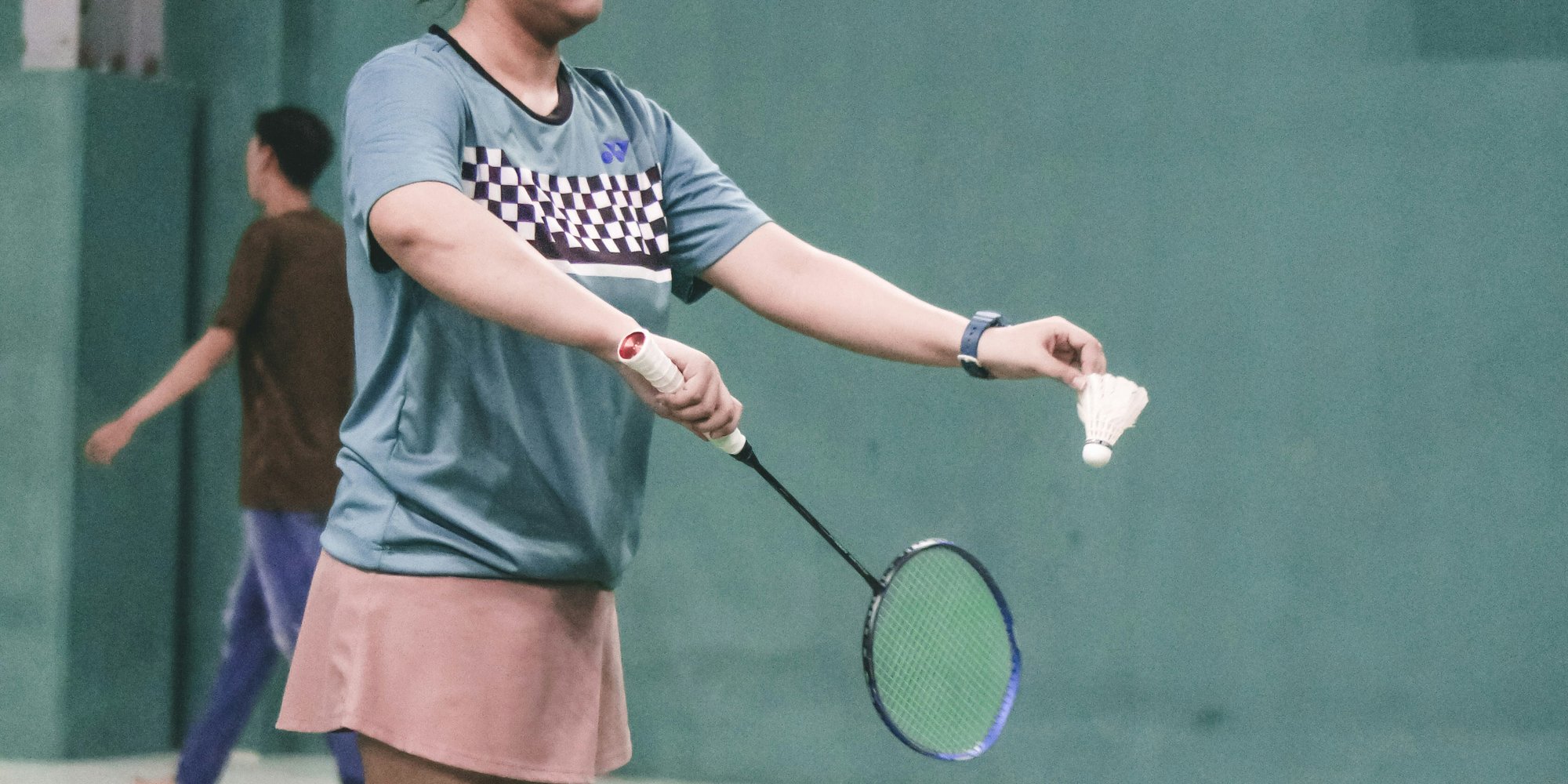
Shuttle. Hold it by the tip of the feathers between thumb and first two fingers, out in front of you, a little to your racket side, with the cork pointing down and slightly towards the racket.
The hit. Short backswing, a few centimetres only. Push the racket forward through the cork with the thumb, as if sliding a book along a table. It’s a push, not a hit. Contact as high as the law allows, which gets the shuttle over the tape faster and flatter. Follow through towards your target, short.
Flight. The shuttle should skim the tape by a few centimetres and be dropping by the time it crosses the short service line. If it’s still rising as it passes the net, you’ve hit it too hard or too low.
Practise until you can hit 18 out of 20 within a shuttle’s length of the short service line. Then start aiming at the lines (more on targets below).
The high forehand serve (singles)
In singles you want the receiver at the very back of their court, hitting from above their head, with time for you to get set. That’s the high serve.
Grip. The forehand (handshake) grip, racket held at the end of the handle for leverage.
Stance. Deeper in your court than for the low serve, around a metre and a half behind the short service line. Non-racket foot forward, body side-on, weight on the back foot.
Shuttle. Held out in front and to the racket side at about chest height, cork down. You drop it, you don’t toss it.
The swing. Racket drawn back to hip height. As you release the shuttle, swing forward and up, transferring weight from back foot to front foot, and brush under the cork with a long follow-through that finishes above your non-racket shoulder. The forearm rotates through contact the same way it does in a smash, just upside down.
Flight. Very high, so it drops nearly vertically on or just inside the back line. A high serve that lands 30 cm inside the line is good. One that drops a metre short is the most punished shot in club singles.
The 1.15 m rule bites here. With a long forward swing it’s easy to let contact drift up. Keep the contact around knee to mid-thigh height and let the swing, not the height, generate the lift.
The flick serve
The flick is a low serve that, at the last moment, isn’t. Same stance, same grip, same backswing, same body position as your low serve. The difference is a sharp acceleration of the thumb and forearm through contact so the shuttle climbs quickly over the receiver’s racket and lands near the back of the service court.
It only works if your low serve is good enough that the receiver is leaning in and creeping forward to kill it. Use it once or twice a game, not as a default: a flick that isn’t fast enough is a free smash.
Targets for the flick in doubles: deep to the receiver’s backhand corner (for a right-handed receiver in the right court, that’s straight; in the left court, it’s towards the centre line). In singles, aim at the back corners.
Drive serve and the forehand low serve
Two serves you see at club level that we’d use sparingly. The drive serve is a flat, fast serve at the receiver’s body or racket shoulder. Good against a receiver who stands tall and upright, risky against anyone with fast hands, and easy to fault on height. The forehand low serve is the traditional doubles serve and still fine if you grew up with it, but it’s harder to disguise and harder to keep low from a forehand swing. If you’re learning now, learn the backhand version.
Placement targets
Where you serve to matters almost as much as how low. For each service court there are three main targets.
| Target | Why | When |
|---|---|---|
| T (where the short service line meets the centre line) | Shortest flight, fewest angles for the receiver, least distance to cover if returned straight | Default low serve |
| Wide (short service line, far side line) | Pulls the receiver out of position, opens the court | Against a receiver who stands near the centre line |
| Deep (flick to the back of the service court) | Punishes a receiver leaning in | When the low serve is being killed |
| Body (drive at the racket shoulder) | Jams a tall, upright receiver | Occasionally, with a reliable serve |
The lines are 40 mm wide and a shuttle touching any part of one is in. Aim for the line, accept a shuttle’s width inside it.
Receiving: a quick word
Your serve is only as good as the pressure the opponent feels. Stand as close to the short service line as you’re comfortable, racket up, weight forward, and move as the shuttle is struck, not before. That pressure forces the server into flicks and misses. If you’re not sure where to stand in doubles after the serve, doubles rotation explained covers it.
A 20-minute practice routine
You need a court (or a net and a line), a basket of old shuttles and ideally a strip of tape on the floor. Do this twice a week.
- Warm-up, 2 minutes. Twenty low serves without a target, just feeling the push.
- Height, 5 minutes. Put a shuttle tube or a bit of tape on the net cord 5 cm above the tape. Serve 40 low serves to the T; the aim is to pass under the marker and over the tape. Count how many clear the net and stay below the marker.
- Accuracy, 5 minutes. Lay a towel or four shuttles in a square at the T, about the size of a hand. Twenty serves to the T, twenty wide. Score it. Write the number down.
- Flick, 4 minutes. Twenty flicks to the back corner of the service court. The goal is for 15 to land inside the long service line.
- High serve, 4 minutes. Singles players: twenty high serves to land within 50 cm of the back line. Doubles players can skip this and do another accuracy block.
Keep a note of the scores. If your T accuracy doesn’t go above 70 percent after a month, film your serve from the side: you’ll almost certainly see a long backswing or your contact height creeping up.
A week of wall work
Tape a line on a wall at 1.15 m and serve beside it for a week. Then do the routine above and write down your T score. Once your low serve is landing within a shuttle’s length of the line 18 times in 20, your doubles partner will stop apologising for you.