If you learned your grip by picking up a racket and hitting, you are probably holding it like a frying pan. Most self-taught players are. The panhandle grip feels natural because the strings face the shuttle, and it works fine for the first few months. Then it stops you ever hitting a proper backhand clear, a deceptive drop or a round-the-head smash, and you spend the next two years unlearning it. Fix how you grip a badminton racket first. Everything else in badminton technique sits on top of it.
The handle has eight sides
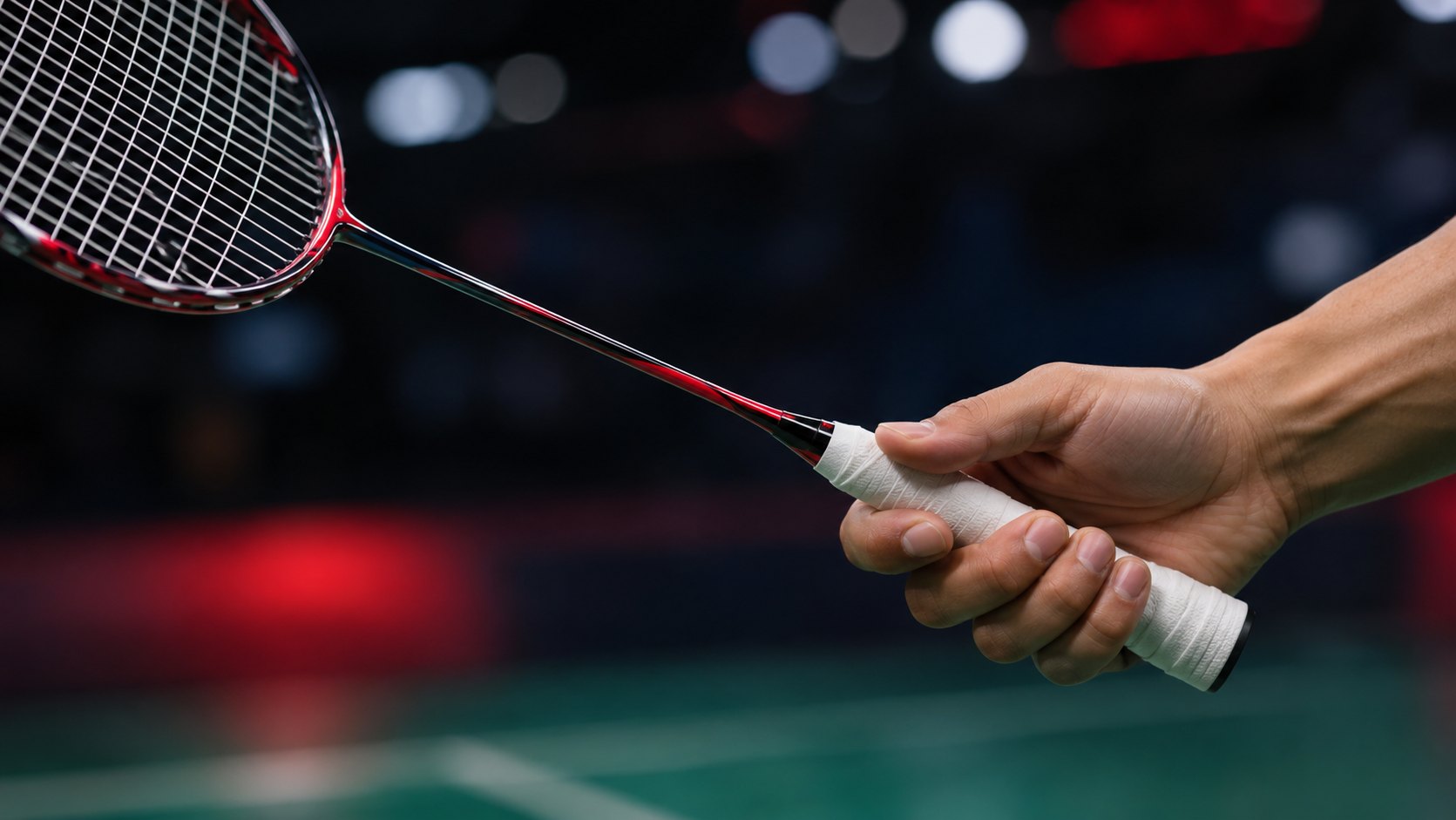
Look at the end of your handle. It is an octagon: two wide flat faces, two narrow flat faces and four bevels between them. Hold the racket out in front of you with the frame vertical, like an axe. The wide faces are now on the left and right, the narrow faces on top and bottom, and the four bevels at the diagonals. Every grip below is defined by where the base knuckle of your index finger and the pad of your thumb sit on that octagon.
Forehand grip: the handshake
This is your base grip, the one you return to between shots.
- Hold the racket by the shaft in your non-playing hand, frame vertical.
- Place your playing hand flat on the strings and slide it down the shaft onto the handle, as if shaking hands with the racket.
- The V between your thumb and index finger sits on the narrow top face. The base knuckle of your index finger sits on the top-right bevel (for a right-hander).
- Spread your index finger slightly up the handle, away from the other three fingers, like you are pulling a trigger. The thumb lies diagonally along the wide left face, not pressed flat along the top.
- Hold it with your fingers, not your palm. There should be a gap between the handle and the fleshy part of your palm. Grip pressure: about a 3 out of 10 between shots.
Check it: hold the racket out and the frame should be edge-on to the net, not facing it. If you can see the full string face, you’ve gone to panhandle.
That finger-not-palm point is the one most beginners get wrong, and it is the one that matters. The handle sits in the fingers so the wrist and forearm can rotate freely. Rotation is where badminton power comes from. A palm grip locks the forearm and forces you to swing from the shoulder.
Backhand grip: the thumb
From the forehand grip, rotate the handle a small amount clockwise in your hand (anticlockwise for a left-hander) so that the pad of your thumb sits flat on the wide face of the handle, pointing up the shaft. The index finger comes down closer to the other fingers.
The thumb is the engine of every backhand. On a backhand clear or drive you push the thumb into the handle through contact, and that push, combined with forearm rotation, is what sends the shuttle. Players who try to hit backhands with a forehand grip, or with the thumb wrapped round the side, hit everything short and wonder why the backhand clear is “impossible”. It isn’t. It’s a grip problem.
Check it: with the thumb grip, the racket face should be pointing roughly straight ahead when your arm is across your body in a backhand position.
Bevel grip: the in-between
For shots around the head on the backhand side, and for a lot of backhand net play and defence, the full thumb grip is too much and the forehand grip is too little. The bevel grip sits between them: the thumb pad rests on the bevel between the wide face and the narrow top face, instead of flat on the wide face.
The bevel grip gives you a racket face that is slightly open to the shuttle on the backhand side without having to rotate the handle all the way to the thumb grip. Advanced players use it constantly for backhand drives, backhand lifts from the net and defensive blocks when the shuttle comes straight at them. You won’t need it in your first month. You’ll need it the moment you start playing doubles seriously.
Panhandle grip: the one you should rarely use
Rotate the handle so that your palm is behind the wide face and the string face points straight at the net, like holding a frying pan. This grip has a few legitimate uses: killing a shuttle that is above net height and very close to the net, and some flat forehand pushes in doubles where there is no time to change. For everything else it is a trap. It takes away forearm rotation, it makes every overhead shot a flat slap with no angle, and it makes the backhand almost unplayable.
If you have been playing panhandle for a while, expect two to four weeks of your shots feeling worse before they get better. That is normal, and it passes.
| Grip | Thumb position | Face angle | Use it for |
|---|---|---|---|
| Forehand (handshake) | Diagonal along wide face | Edge-on to the net | All forehand shots, overheads, serves; the default |
| Backhand (thumb) | Flat on the wide face | Square on the backhand side | Backhand clears, drives, lifts, backhand serve |
| Bevel | On the bevel between wide and top face | Slightly open on the backhand | Round-the-head, backhand net, straight defence |
| Panhandle | Behind the wide face | Square to the net | Net kills above tape height, the occasional push |
When to change grip, and how fast
You change grip for almost every shot, and you do it between shots, not during the swing. The change is a small rotation of the handle with the fingers, driven mostly by the thumb and index finger, while the other fingers relax. It should take a fraction of a second and happen as the shuttle leaves your opponent’s racket.
The reason you hold the racket lightly between shots is exactly this: a tight grip can’t rotate. Relax at 3 out of 10, change, then squeeze to 7 or 8 for the instant of contact, and relax again. Players who grip hard all rally long are stuck in one grip and have slow, tired hands by the third game.
In fast doubles defence you’ll sometimes hold a bevel or thumb grip for a whole exchange because there is no time to go back to forehand. That’s correct. The forehand “default” is a resting position, not a law.
Grip size and overgrip thickness
The G number on a racket is the handle circumference. G5 is the standard on current Yonex and Victor frames and on most of the Li-Ning models in our racket database; some Li-Ning frames come in G6 or Li-Ning’s own S-sizes. Each step is about 3 mm (one eighth of an inch) of circumference, and the smaller the handle, the bigger the number: G4 is thicker than G5, which is thicker than G6.
Smaller is usually better for badminton. A thinner handle lets the fingers do the rotating and makes grip changes quicker. A handle that is too thick forces the palm onto the handle and you’re back to the frying pan. The test is the forehand grip itself: with a correct handshake grip, the tip of your middle finger should come close to the base of your thumb without crushing it. If there is a big gap, the handle is too thick; if the fingers overlap heavily, it’s too thin.
Overgrips add thickness, so plan for them. Yonex’s Super Grap, the most common synthetic overgrip, is 0.6 mm thick and 25 mm wide; one layer wrapped with the usual half-overlap adds roughly 1 to 1.5 mm to the circumference. Towel grips are thicker again and absorb more sweat, but they get heavy and smelly, and they need replacing often. Two things to avoid: stacking two or three overgrips because the handle “feels thin”, which turns a G5 into a club, and the common habit of stripping the original cushion grip and applying one overgrip straight onto the wood, which makes the handle very thin and hard. Both change the racket’s balance too.
If your hands sweat heavily, a thin towel grip or a “dry” overgrip over the original base grip is the usual compromise. Replace any overgrip when it goes shiny.
Common faults and how to fix them
Palm grip. Handle pressed into the palm, no gap, fingers bunched. Fix: hold the racket by the throat with the other hand, let the playing hand hang loose, then close only the fingers. Shadow-swing 20 forehand clears feeling the handle in the fingers.
Index finger wrapped under the middle finger. Removes your trigger finger and most of your control. Fix: consciously spread the index finger up the handle each time you re-grip.
Frying-pan overheads. Flat face, slappy sound, no angle on the smash. Fix: start every overhead from the handshake grip with the frame edge-on, and let forearm rotation turn the face into the shuttle.
Thumb round the side on the backhand. Short, weak backhands. Fix: before every backhand, feel the thumb pad flat on the wide face. Hit 30 backhand drives against a wall with the thumb pushing through.
Death grip. Forearm tight all rally, slow hands, sore elbow. Fix: between shots, wiggle the fingers. If you can’t, you’re too tight.
Drills that build the grip
- Grip-change shadowing, 2 minutes. Stand in ready position. Say “forehand, backhand, bevel, forehand” and change on each word without looking at the racket. Build to a change every half second.
- Wall drives, 50 forehand, 50 backhand. Stand two metres from a wall and drive a shuttle against it. Forehand side in handshake grip, backhand side in thumb grip. You cannot do this with a panhandle; that’s the point.
- Finger spins, 1 minute each direction. Spin the racket a full rotation in your fingers using thumb and index finger only, without the palm. Builds the finger control that grip changes need.
- Shuttle bounce, 100 bounces. Bounce a shuttle on the strings, alternating forehand face and backhand face. Each face change is a grip change.
- Multi-feed with a partner, 20 shuttles. Feeder alternates random forehand and backhand lifts. You call the grip aloud before each hit for the first ten, then silently.
Ten minutes of these before every session for a month will do more for your game than a new racket. Once the grip is automatic, our racket buying guides and the beginner racket guide will mean a lot more, because you’ll be able to feel what the specs are describing.