
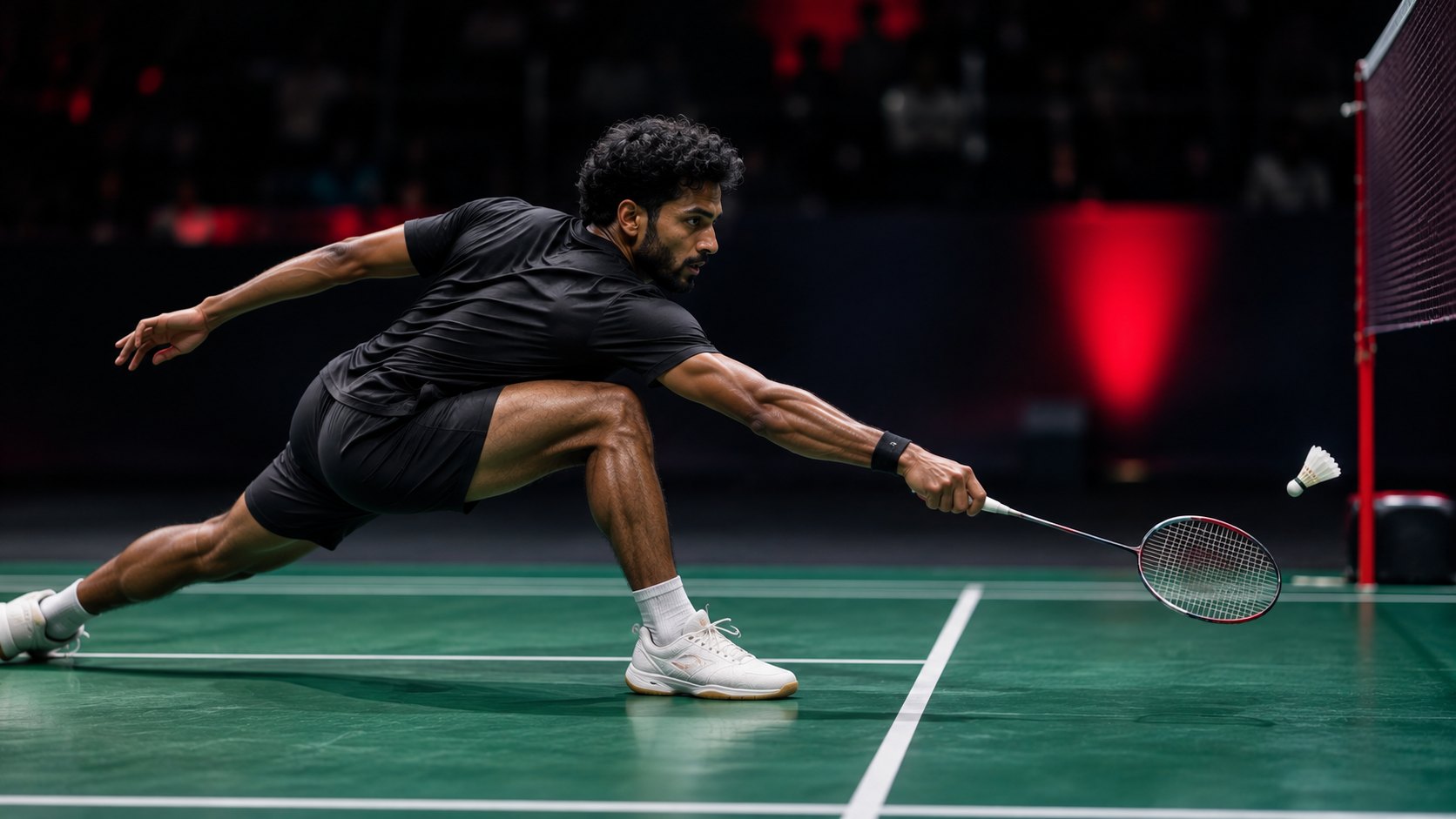
 AI-generated image
Fitness: look after your body
Badminton asks a lot of ankles, knees and shoulders: hundreds of lunges and overhead swings in a session. Ten minutes of preparation and two short workouts a week go a long way.
A 10-minute warm-up
Start slow and build. A warm-up should leave you mildly sweaty, not tired.1 Do it on court before your first rally, not after, and keep it moving: in a meta-analysis of injury-prevention trials, stretching on its own showed no clear protective effect.2
- 0–3 minRaise the pulseEasy jog round the court, side steps, skipping. Breathing up, still able to talk.
- 3–5 minMove the jointsAnkle rocks against the wall, leg swings front-to-back and side-to-side, walking lunges with a twist, arm circles and slow overhead swings with the racket.
- 5–8 minFootwork patternsSplit step, then chassé to each corner and back to the middle. Shadow lunges to the net at half pace, then three-quarter pace.
- 8–10 minBuild the shotsGentle drives and clears with a partner, getting longer. Net shots. Save smashes for the last minute, and start them at half power.
Six common injuries, and how to dodge them
In studies of elite players, most badminton injuries are to the legs, with the knee and ankle at the top. Overuse injuries are about three times as common as sudden ones, and nearly all shoulder and arm problems come from overuse.3 The best-evidenced fix is boring: in that same meta-analysis, strength training cut sports injuries to less than a third.2
Ankle sprains
Rolling over on a lunge or landing. Prevent: proper indoor court shoes with a low, grippy sole, balance work (single-leg stands), and recovering to the centre rather than lunging off-balance.
Achilles tendon
One of the most common problems around the ankle.3 Prevent: calf raises twice a week, a full warm-up, and building playing time gradually after a break.
Knee pain
Front-of-knee pain from repeated lunging and jumping. Prevent: squats and split squats for strength, knees tracking over toes in the lunge, and rest days between hard sessions.
Shoulder overuse
The most common upper-body complaint, often rotator cuff tendon irritation.3 Prevent: band rotations, a coach checking your overhead technique, and not smashing every shot.
Elbow pain
In badminton usually on the inner side of the elbow, from repetitive wrist and forearm loading.3 Prevent: a relaxed grip, the right grip size, sensible string tension, and building volume slowly.
Lower back
Muscle strain from twisting and reaching for shuttles behind you.3 Prevent: core work, getting behind the shuttle with your feet rather than bending backwards, and a proper warm-up.
Pain that lasts more than a few days, swelling, or anything that changes how you walk or lift your arm: stop playing and see a doctor or physiotherapist. A sudden snap or kick at the back of the heel needs urgent attention. Protective eyewear is worth considering in doubles, where eye injuries are a known risk.3
Drink and eat sensibly
- Arrive hydrated. Drink normally through the day so you start the session topped up.45
- Keep a bottle courtside. Sip between games rather than waiting until you are parched. The American College of Sports Medicine’s guidance is to drink enough to avoid losing more than about 2% of body weight in sweat; weighing yourself before and after a session shows how much you lose.45
- Eat two to three hours before. A light meal built on carbohydrate (rice, pasta, bread, potatoes) and not too fatty.6
- Water is usually enough. For an ordinary club night with a normal diet you most likely don’t need a sports drink; they earn their place in hard sessions of over an hour or long tournament days.56
- Refuel afterwards. Carbohydrate soon after playing, as part of a meal or a snack, helps your muscles restock.56
- Skip the supplements. They are no substitute for a varied diet; talk to a registered dietitian first if you are curious.6
Simple workouts off the court
WHO recommends muscle-strengthening work on two or more days a week.7 For badminton, these four groups cover most of what the game asks for. Two sets of 8–12 slow, controlled reps is a fine start; add load only when the last rep feels easy.
Legs
Squats, reverse lunges or split squats, calf raises (straight and bent knee).
Core
Front plank, side plank, dead bugs. 20–40 seconds each to begin.
Shoulders
Resistance-band external rotations and band pull-aparts, light and smooth.
Agility
Shadow footwork to the six corners, skipping, side-step ladders.
A beginner’s week
A starting point, not a prescription. Swap days to fit your club nights, and keep at least one full rest day.
| Day | What | Time |
|---|---|---|
| Mon | Club night: warm-up, games, cool-down | 90 min |
| Tue | Workout A: squats, calf raises, plank, band rotations | 20–25 min |
| Wed | Rest or an easy walk | – |
| Thu | Club night or a hit with a friend | 60–90 min |
| Fri | Rest | – |
| Sat | Workout B: reverse lunges, side plank, pull-aparts, shadow footwork | 20–25 min |
| Sun | Rest or something different: swim, cycle, walk | – |
Sources
7 sources for this page, checked 2 November 2026
- Mayo Clinic: How to warm up
- Lauersen J. B., Bertelsen D. M., Andersen L. B. (2014). The effectiveness of exercise interventions to prevent sports injuries: a systematic review and meta-analysis of randomised controlled trials. British Journal of Sports Medicine 48(11), 871–877
- Pardiwala D. N., Subbiah K., Rao N., Modi R. (2020). Badminton injuries in elite athletes: a review of epidemiology and biomechanics. Indian Journal of Orthopaedics 54(3), 237–245
- American College of Sports Medicine (2007). Position stand: Exercise and fluid replacement. Medicine & Science in Sports & Exercise 39(2), 377–390
- nidirect (Northern Ireland government): Eating well for sport and exercise
- British Dietetic Association: Sport and exercise (food fact sheet)
- World Health Organization: Physical activity, recommendations for adults