
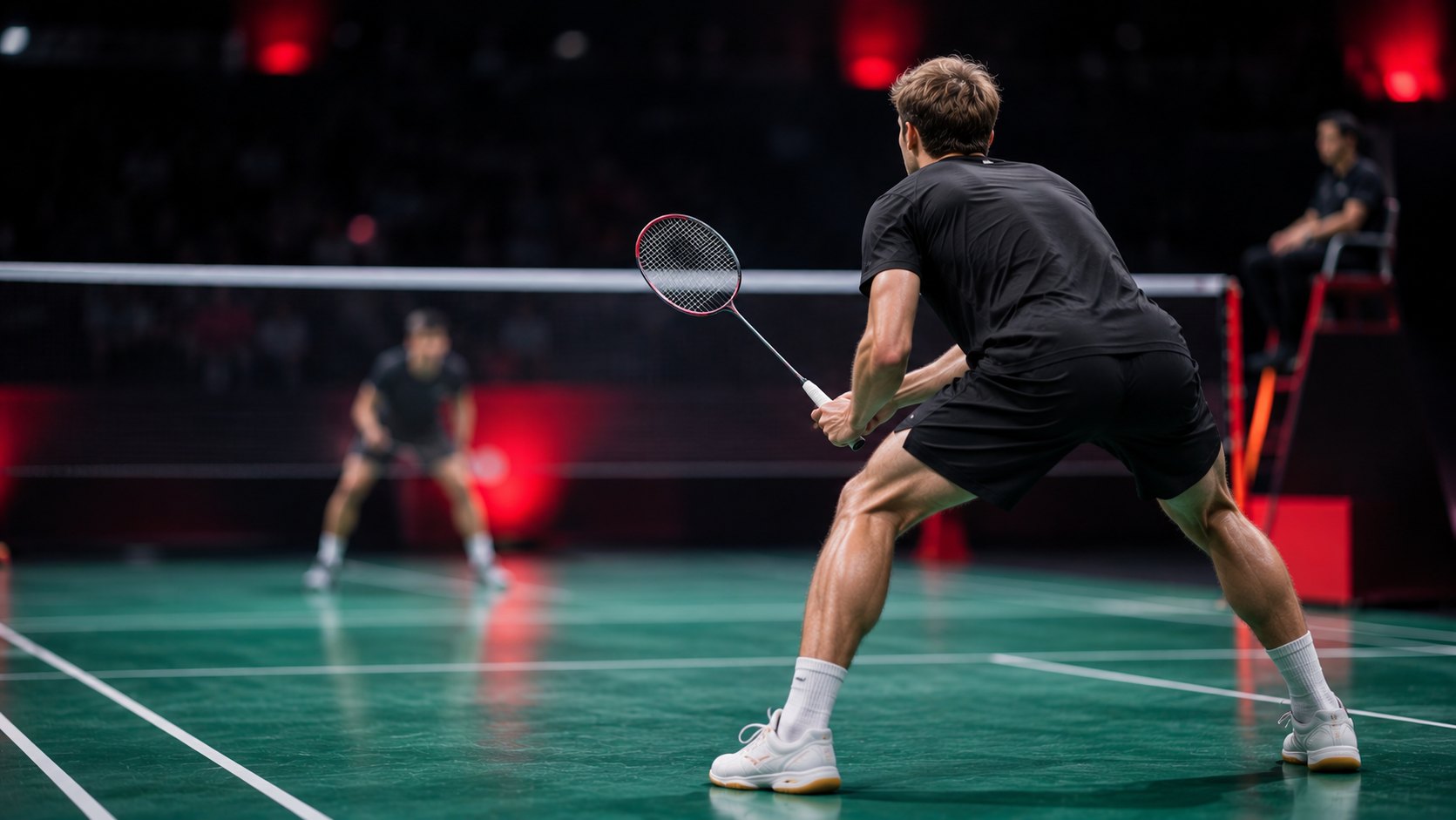
 AI-generated image
Why badminton: what makes the sport special
It is the quickest hit in any racket sport, and a game you can start in an afternoon. Here is what sets it apart.
Speed and flight
A shuttlecock leaves a top player’s racket faster than anything else in racket sport, then loses most of that speed before it reaches the other side. That odd combination, brutal speed and sudden slowness, is the whole game.
The fastest hit in racket sport
The Guinness World Record for the fastest badminton hit belongs to India’s Satwiksairaj Rankireddy: 565 km/h, measured with a high-speed camera at a Yonex gymnasium in Saitama, Japan, on 14 April 2023. Malaysia’s Tan Pearly set the women’s mark the same day, 438 km/h.123 Those were set in a test session, not a rally. The fastest hit recorded in competition is Mads Pieler Kolding’s 426 km/h in an Indian league match in January 2017.4
A projectile that brakes itself
A shuttle weighs about five grams and is shaped like an open cone of 16 feathers, so air resistance dominates its flight.56 Instead of a smooth arc it flies fast and flat, then drops almost vertically. Physicists in France found that above a certain launch speed, hitting it harder barely adds distance: drag eats the extra pace. They called it the aerodynamic wall.7 That is why a clear needs timing more than muscle, and why a drop shot can die a metre past the net.
Reflexes you can train
Because the shuttle starts so fast, rallies at the top level are decided by reading the opponent’s body before contact, not by reacting after it. The good news for newcomers is that this is a skill, not a gift. Early split steps, a ready racket and watching the hitter’s shoulders all buy time, and they come with practice.
A game for almost everyone
You can play a gentle rally with a child on the first day and still be learning at 70. Doubles cuts the court you cover in half, and para badminton, played seated in wheelchairs and standing, has been on the Paralympic programme since Tokyo 2020.8 As for how many people play, BWF says more than 300 million.9 That is the governing body’s own figure, not an independent count, so treat it as a ballpark; BWF’s separate fan study put followers of the sport at about 709 million.10
Singles, doubles and mixed
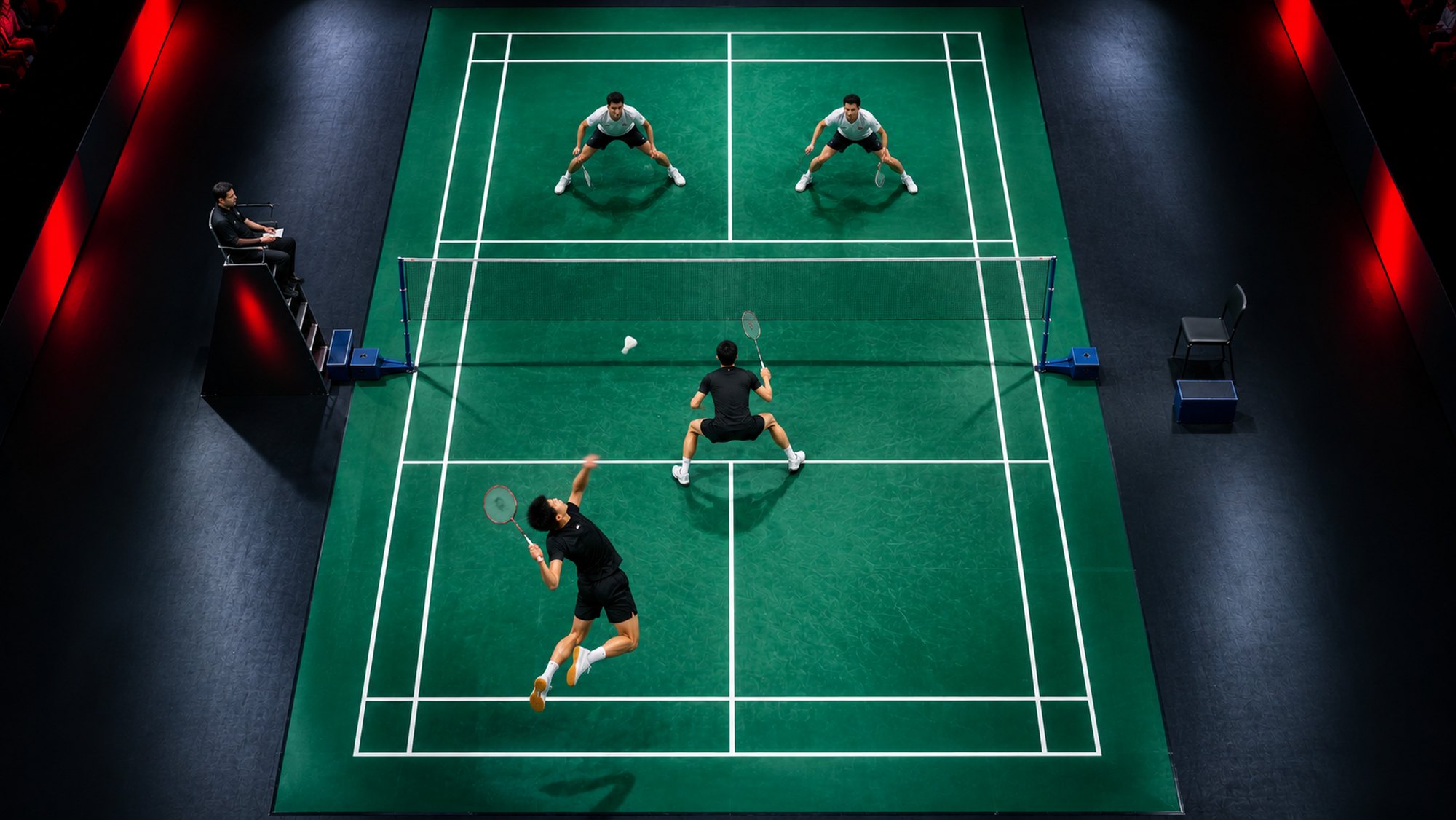
The court is 13.40 m long. Singles uses the narrow inner side lines (5.18 m), doubles the full 6.10 m.11 Five events are played at the Olympics and on the tour.12
- SinglesOne against one. Long rallies, deception and a lot of running. The purest test of fitness.
- DoublesTwo against two. Faster, flatter, more attacking. Pairs rotate between front-and-back attack and side-by-side defence.
- MixedA man and a woman per side. Classic roles put one player at the net and one at the back, though the best pairs blur them.
Sources
12 sources for this page, checked 2 November 2026
- Guinness World Records: Fastest badminton hit (male)
- Guinness World Records: Fastest badminton hit (female)
- Yonex: Satwiksairaj Rankireddy and Tan Pearly smash Guinness World Records (2023)
- Guinness World Records: Fastest badminton hit in competition (male)
- Encyclopaedia Britannica: Badminton
- Cohen C., Texier B. D., Quéré D., Clanet C. (2015). The physics of badminton. New Journal of Physics 17, 063001
- Texier B. D., Cohen C., Quéré D., Clanet C. (2012). Shuttlecock dynamics. Procedia Engineering 34, 176–181
- International Paralympic Committee: Badminton set to make Paralympic Games bow at Tokyo 2020
- BWF: About badminton
- BWF: Badminton global fan, commercial and broadcast figures (January 2023)
- BWF Statutes, Section 4.1: Laws of Badminton
- Olympics.com: Badminton Olympics winners, the full history